Friday, 8 May 2015

National Museum and Rinchen Pung Dzong, Paro

Continued from "Sangchhen Dorji Lhuendrup Nunnery"...

Paro was next in our itinerary. The National Museum happens to be an old watch-tower (of the Paro Dzong that is situated down the hill). This conch shell-shaped watch-tower was renovated during 1968 as a museum. The watch-tower, which was the original museum, was destroyed by earthquakes, and was under renovation. The artifacts were all moved to a near by building that acts as the museum.

The museum houses masks with descriptions and with information about the dances during with the masks are worn. There's also a video to watch. A lot of sacred pictures and paintings too are showcased in the museum. Photography is strictly prohibited inside the museum.

I loved the masks section; made rough sketches of the masks, in my notebook. Another favorite section was that of Bhutan's biodiversity - mammals, birds, fauna, and floral. Photos about birds and its descriptions can take an hour to read. Bird calls are recorded, and I liked listening to the calls. It was here that I chit-chatted with a guide who told me about the birds that his tourist group had spotted, and met an Indian elderly lady from Europe who was as mesmerized as I was with the variety of birds of Bhutan.

Down the hill is the Paro Dzong or Rinchen Pung Dzong, which translates to "Fortress of a Heap of Jewels." This dzong was built by Guru Rinpoche, and later Zhabdrung Ngawang Namgyal constructed the new dzong on the same foundation. There's so much to know about this dzong. Read "Paro Dzong."

I enjoyed the walk on the traditional wooden covered bridge on the Paro Chu.  I also enjoyed the walk from the dzong down to the town. The path is the lined with lush green trees. I was questioned our guide about where the youngsters where, and well, this is where I saw one or two teenage couples!
National Museum Notice

Entrance, and the stone piles

The watch-tower under renovation

Paro Dzong and the surrounding, from the hilltop

The dzong

Wheel of life painting

Guru

Paro Dzong Courtyard


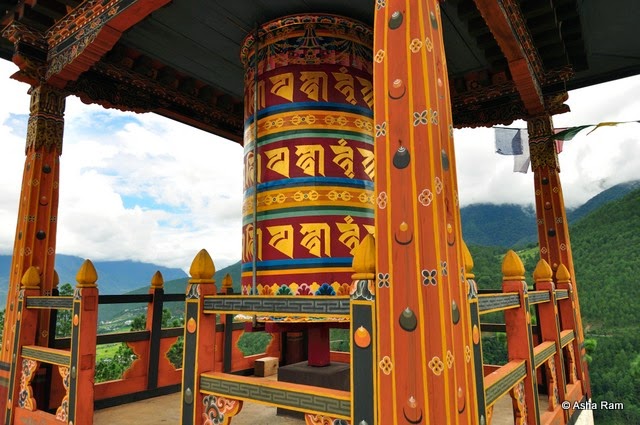
Prayer wheels

See how much Bhutanese love their chillies :-)
The walk-path leading down hill

The bridge entrance

The wooden covered bridge
Regards,
Asha

Thursday, 7 May 2015

Sangchhen Dorji Lhuendrup Nunnery, Punakha

Continued from "River Rafting"...

[Participating in Thursday Challenge - "Peaceful" (Landscapes)]

The next place of interest was the Sangchhen Dorji Lhuendrup nunnery, built at Omolatsekha. The monastery has a two-storied temple, a chorten in Nepal's style of architecture, and a nunnery complex. Well, yes, it's all about the location, isn't it? The nunnery is at an absolute stunning location, onlooking the different valleys.

The temple has one of the biggest Avalokiteshvara bronze statue along with staues of Guru Padmasambava, Lord Buddha, Zhabdrung Ngawang Namgyel, Tsela Namsum, 21 Taras, and Tsepamay. This place oozes serenity. Photography is prohibited inside the sanctum.

The nunnery has a learning center, computer center, library, and meditation center. There were about 40-45 nuns when I visited. The nuns maintain the garden. They were planting new plants, and seemed to enjoy the activity and the sunshine. A few nuns were studying. One nun sat near a prayer wheel, faced the valley, and quietly studied. That was a mesmerizing sight!

I understand that most of the young girls were either abandoned or orphaned. Life hasn't been easy for them but for the nunnery, I guess. We take so much for granted, in our easy lives; create issues for ourselves and others. For a second, if we can visualize the difficulties that these girls would have faced, we will be grateful for living a comfortable life.

Teaching these girls vocational skills along with providing basic education will definitely help them. I had bought a few locally grown apples at the morning market, and offered the fruits at the sanctum. For sure, the fruits would be distributed and consumed. The donation box is inside the sanctum; can drop cash into the box. Best part of monasteries at Bhutan is that they accept not just cash but also anything you are willing to offer. I have offered biscuits, fresh fruits, chocolates, and whatever I had saved for myself. I wish that I had known earlier... Would have purchased some notebooks or other educational books for the girls at the nunnery. Well, there's always a next time!

The beautiful lamp-post

The monastery complex

Close-up of temple

The prayer wheel

Stupa resembling the ones at Nepal

Ring them?


Girls busy gardening

View of the valley

Clouds seem to be exploding from the mountain tops!
Regards,
Asha

River Rafting, Punakha

Continue from "Khamsum Yulley Namgyal"...

What's on my list-of-things-to-do during my next visit to Bhutan? River rafting!

When I saw a group of tourists (Chinese, said our driver) starting their river rafting at the suspension bridge, Khamsum Yulley Namgyal, I too wanted to river raft. I stood like a kid, watching them prepare to raft.

River rafting is available on both Pho Chu and Mo Chu rivers. The Pho Chu river's course is about 16 kms with about 15 rapids; while that of Mo Chu is 10 kms with about 10 rapids. Both routes meet at the confluence of the rivers, forming Puna Tsang river. The Punakha Dzong from the raft may look spectacular! For more information, search for White Water Rafting in Bhutan.

The Punakha Valley has an option available for casual raft; contact the rafting agencies, such as Druk Rafting Services. Best time to raft is from March till October. Also ensure that you have a travel insurance that covers adventure sports.

Sharing a few photos...

The Mo Chu

One of the rafting instructors

The group getting ready

All set! Ready, steady, and RAFT
Regards,
Asha

Khamsum Yulley Namgyal, Punakha, Bhutan

Continued from "Chime Lhakhang"...

My first glimpse of the Khamsum Yulley Namgyal - at an altitude, a tiny shiny chorten surrounding by thicket of trees, with a backdrop of clouds garlanding the mountain ranges! Yes, had to trek up the hill, and my temptation to trek was... the wonderful views of the Punakha Valley.

This is a four-storey chorten, constructed over a period of nine years, and built by the Queen Mother to ward off evil forces and to promote peace in the kingdom. It is said that the Queen Mother treks to the chorten and resides at her quarters opposite to the temple.

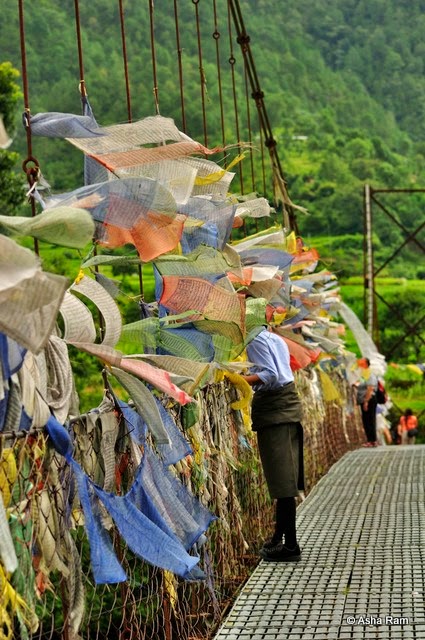
The trek is approximately an hour or more on a good day. From the parking space, I crossed the suspension bridge and walked through the paddy fields, and then began the trek. The suspension bridge has so many prayer flags tied to it. Our guide was head-deep in the flags (; see the photo!). There are a lot of birds in this region; saw plenty of treepies. Also saw a group of tourists (Chinese?) river rafting. See River Rafting, Punakha.

As I began my trek, rain, the jealous friend, began to pour. I had to struggle with my camera and umbrella and my unfit body. Luckily, I never forgot to carry an umbrella. The rain made the path a little slippery; a hiking stick is always helpful.

After the climb, the vastness of the chorten complex is pleasant. The White miniature chortens surrounding the Namyal are pretty. The White color cuts the monotony of the greenery behind the chortens. I loved the climb to the top of the chorten. A door, leading to the top, was closed due to rain; but the guide opened it, and I climbed up. I stepped on the rain water, wetting my socks; but was worth every trouble. The view of the valley was fantastic! Please remember that photography inside the chorten is prohibited.

Sat till the rain stopped, and then re-traced my steps back to the parking lot. What a fun trek it was!

First glimpse of Khamsum Yulley Namgyal

The suspension bridge

The clouds

Our guide head-deep in prayer flags!

The vast space
Miniature chortens

The top of the chorten
At the top

View from the top

View from the top (Queen Mother's quarters)

Water goddess?
Regards,
Asha

Chime Lhakhang, Punakha, Bhutan

Continued from "Punakha Dzong"...

The next visit was to the Chime Lhakhang. The 14th Drukpa, Ngawang Choegyel, constructed this monastery during 1499. The legend says that the Divine Madman or Mad Saint, Lam Drukpa Kuenley, fought a demoness and trapped it in a rock near the chorten.

Our guide informed me that we needed to hurry because he thought that the monastery would close. Oh, I walked in such a hurry! But as we approached the monastery, the guide said that some religious ceremony was talking place, and that the shrine would be open for a longer time. From hurrying me unnecessarily, I muttered, "Idiot!"

The walk from the parking area to the monastery was serene. Walking through the village road and through the fields was a nice experience. A stream flowed gently. Prayer flags were never tired of waving. Children played on the road, in the mud, and seemed happy. Sighted a variety of birds and butterflies!

The Divine Madman instructed the villagers to install wooden phallus on their house tops in all four corners, to ward off evil eyes and gossips. There are shops selling interesting souvenirs. Please don't act silly or stupid when you see the explicit images of the phallus. Just respect the culture, and act as mature human beings!

This monastery is square shaped, and near the entrance is a tiny chorten that marks the location of the demoness killed by the Divine Madman. The temple walls are lined with have prayer wheels. It's fun to rotate them one after another. At one end of the hillock, prayer flags are lined up.

The inner sanctum has pretty bells, drums, and other things. The Divine Madman's statue can be seen at the altar, along with his dog. A lama strikes couple/women seeking to beget children with the divine wooden phallus decorated with silver handle. After a child is born, the parents bring the child to the monastery for blessings and to pick a name for the child.

TIP - Toilets: The souvenir shops have toilets. If you can't find one, ask your guide.

The gorgeous walkpath to Chime Lhakhang 

Kids playing in the village

Prayer flags on the walkpath

The farmhouses 

Paddy

One of the many paintings of phallus on the walls of houses
The uphill climb

Another view of the cloud-covered mountain ranges
The description of temple

Chime Lhakhang side-view

Prayer flags

The Chime Lhakhang with the monastery and chorten
Regards,
Asha