Wednesday, 6 May 2015

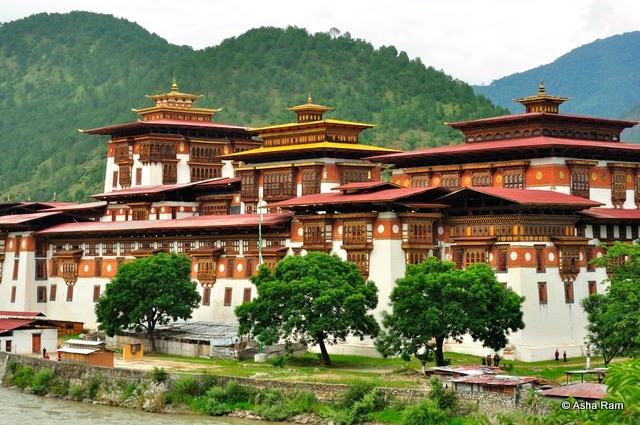
Punakha Dzong, Bhutan

Continued from "Drive from Dochula Pass to Punakha"...

Punakha is the winter capital of Bhutan. The Pho Chu (male) and Mo Chu (female) rivers make the Punakha vallery fertile. The Pho Chu river receives water from the northern hills of Lighsi and Laya; the Mo Chu receives water from glaciers in the Lunana region. The main river is known as Puna Tsang Chu. The paddy fields add glamour to the place.

In 1637, Shabdrung Ngawang Namgyal constructed the famous Punakha Dzong at the confluence of these two rivers. The Dzong serves both as a religious and administrative center. From an angle, the hill looks like an elephant trunk. People also believe that the architect, Zowe Palep, had a dream in which he visioned the complete architecture of the Dzong, and constructed as per this vision. This Dzong has survived earthquakes and fires.

The wooden cantilever bridge installed to cross the Mo Chu river is very beautiful. I loved watching the river below. After rotating a prayer wheel at the beginning of the bridge, I walked the bridge. For me, walking on this bridge was a romantic experience. The greenery, the rivers, the mountain ranges, the valley, the zero-pollution environment, and the silence are something that seized my senses, and cleaned my aura.

After climbing the stairs of the main entrance, I was greeted by the colorful paintings of the Gurus. The prayer wheels looked like pillars holding the main entrance. The paintings of the Four Friends and the Wheel of Life adorn the walls.

A White stupa greeted me, as I entered the main portion of the Dzong. The courtyard is surrounded by the beautifully decorated wooden structure/balconies. The Dzong is divided into two sections - Administrative and Religious. Tourists are strictly prohibited from entering the Administrative section. The religious section is open for public; please remove your footwear before entering the sanctum. The inner sanctum is absolutely gorgeous with the Buddha and the gurus.

There's a shrine built for Tsomen, a mermaid-like spirit, who supplied rocks from the river to build the dzong. A butter-lamp is lit in front of the shrine and rock offerings are made. The painting of Tsomen and a rock can be seen inside the sanctum.

In Bhutanese culture, every element of nature is given importance. They respect legends as well. I loved listening to the legends. :-)

TIP - Dressing Etiquette: Remember to dress appropriately when visiting a dzong. Idea is to cover your body completely except your face, hands, and feet. Wear long length clothes and full-armed tops/shirts/jackets. No need to cover the head. Also remember to never ring a bell, if you see one!

Punakha Dzong in its best elements

A glimpse of the dzong from the road

Punakha Dzong 

The bridge tower

The cantilever bridge to Punakha Dzong

The Mo Chu river flowing under the bridge

The dzong entrance

Paintings

Paintings

The prayer wheel

The stupa

The wooden structures inside the dzong

At the dzong complex

The Tsomen shrine

The religious section

A glimpse at the artistic work

Thirsty pigeons
Regards,
Asha

Tuesday, 5 May 2015

Drive from Dochula Pass to Punakha

Continued from "Drive through Dochula Pass"...

From the Dochula Pass, drive to Punakha was humpy-bumpy due to road construction; however, the scenery was beautiful. The mountain ranges wore a thick carpet of shades of green. The clouds had covered most of the ranges. The pine trees stood still. The colorful prayer flags waved a bye. The road curved down to the lowlands of the valley. One painful issue was about finding clean toilets on this road especially when traffic had stopped due to construction and everyone had to wait for an hour at least.

The rural scenery is fantastic; rice terraces, cute traditional houses, and a lot of birds. Bhutanese love chillies; can see chillies drying outside houses. We stopped at a local hotel for lunch; drank butter tea and hogged on traditional Bhutan food (salad, rice, sauteed vegetables, curries, fruits, and so on). Bhutanese love to feed people! Sorry, I don't recollect nor have I written down the name of the hotel that we stopped for lunch. I can only remember the taste, ambiance, and the great scenery!

From here, our drive continued towards the temples of Punakha.

I'll let the photos do the narration. Enjoy :-)


Regards,
Asha

Drive through Dochula Pass


Continued from "Early Morning Stroll in Thimphu"...

We drove from Thimphu to Punakha, excited to get a glimpse of the Himalayan range at the Dochula Pass. On a good day, the Himalayas can be seen from this pass. Our fingers were kept cross, hoping that the weather would be good.

The hill ranges were covered in green vegetation. A farmer was walking his horses; he would walk all the way (some kilometers) to reach his destination. Well, the weather was not cooperating; mist still covered portions of the vegetation. Tough luck to see the Himalayas!

When we reached the Dochula Pass, 108 chortens or stupas greeted us; mist was lifting off to reveal the chortens. This is also know as the Druk Wangyal Chortens. What a spectacular spot! The Queen Mother, Ashi Dorji Wangmo Wangchuck, got the monument built in honor of King Jigme Singye Wangchuck.

You can romance not only the beautiful scenery but also the silence, at this spot. Just round the corner, road construction work was in full swing. The Pass or the road was open for a few hours in the morning, afternoon, and evening for vehicles to commute; at other times, vehicles had to wait for hours for the road to open again.

When the mist covers the place, please exercise caution while walking at the edge of the cliff. One slip will land you some feet below, and rescuing will be a challenge that is if you are still alive. Lot of birds live in this region; we heard their morning chaos and saw minimum number of birds (due to unclear weather). Carry an umbrella or wear a raincoat; chances of a drizzle or rain is high at this pass. During the tourist season or holidays expect a lot of vehicles and people.

I was thrilled to met two Kannadiga families; chatted with them and got my solo photo clicked, and wished them a safe journey. Exchanged a word or two with a Germany handsome couple, clicked their photo, and bid goodbye.

On route

108 Chortens


Road construction work in progress

I felt a spiritual aura at the Druk Wangyal Chorten. If you visit this place, let me know your experience.

Regards,
Asha (Sep 2014)

Monday, 4 May 2015

Early morning stroll in Thimphu

On the day we were departing from Thimphu, I went for a walk with my camera to capture the morning activities at Thimphu. As I stepped out, the prayers and drum beats from the opposite hotel greeted me. Smoke from incense sticks sneaked out from the rooftop of the hotel and glided down on to the footpath.

The mist was reluctantly detaching from the hills. Adults and children, dressed in their traditional clothes, were going to their offices or schools. Cars had already warmed up, and were following traffic rules. The famous traffic policeman enacted his role of regulating the thin traffic. He was trying hard to control his smile, as I photographed him and his morning drama. I strongly believe that he (and his traffic-post) is the most photographed person at Thimphu!

I walked further down, and saw the almost empty streets. Previous evening, the streets were packed with people - locals and tourists. Shops, bars, and eat-outs were filled with people. Some men were drunk and high. The strange silence (of the morning) hit me hard like a ball of snow. Just as I was thinking to myself, "Well, yes, I could get used to such serenity," I saw a lady talking nonstop over the cellphone. That's the universal silence breaker.

One question that I had was about how Thimphu manages its waste. I hesitated asking this question to our guide because I knew eyebrows would be raised and I would get a monosyllable reply. Later during the travel I researched online and found out that the Bhutan government has two plans - Clean Bhutan and Green Thimphu. The Clean Bhutan project is to clean the rivers and other water sources. Currently, most of the waste was being used in landfill. The government aims to reduce the percentage of waste in landfill and practice - Rethink, Reduce, Recycle, and Reuse - to attain zero waste.

I saw garbage collection trucks taking all the waste. In one of my photo collages, you can see a sample segregation of waste - cardboard, hardboard, and so on. Garbage was neatly placed inside the bins; no spill. As tourists, it's our duty to respect the place's effort towards a clean-green environment, and to act responsible. Of course, we have a lot to learn from this little place. For further reading, refer Waste Management Policy in Bhutan.

I found a cute little bookstore; was glad that it was open early. Went inside, picked a book, got a discount because I was the first customer, and left. I would have walked further down but realized that our guide and driver would soon arrive. I re-traced my steps to the hotel. When I walked up the road, the board - Swiss Bakery - teased me again. Reviews (on travel websites) mentioned that this bakery has delicious pastries and savory dishes; but throughout our stay at Thimphu, the bakery remained closed. Absolute tease!

The famous traffic policeman and his surroundings


I enjoyed my morning walk; I hope that you enjoyed reading about it.

Good day!

Regards,
Asha (Sep 2014)

Monday, 5 January 2015

Photo-blog of Sri Lanka

We traveled to Sri Lanka during December 2014 and early January 2015, and thoroughly enjoyed the place and everything it had to offer. Due to cyclone, we faced rains, witnessed overflowing rivers, water rushed into houses, landslides, fallen trees, roads covered with water, and traffic jams. Made us wonder how bad the place would have been during the tsunami. What has to be appreciated is that the  transportation authority quickly cleared the roads, and road construction work progressed even in rains! The roads at Sri Lanka are fantastic; it's a pleasure to drive on such roads.

We traveled Sri Lanka (SL) for 11 days from Bangalore - Colombo - Sigiriya - Kandy - Nuwara Eliya - Yala - Bentota - Colombo - Bangalore. We had a car and the driver-cum-owner at our disposal. The road-trip was fun, and we enjoyed the freedom to stop wherever we desired. This brief visit gave us a glimpse into cuisine and the colonial influence, culture, and life style of SL. The countryside is stunning with lush green paddy fields, pregnant lakes and rivers, and numerous birds (local and migratory).

I wish to elaborate, but I can only summarize our travel experience.

Cuisine: That being Christmas and New Year season, almost all hotels and resorts had an interesting spread of dishes and wines; most colorful and tasty were the desserts. Aren't the photos tempting? :-)


The center photo is of curds made from buffalo milk, sold in plenty, and served with palm sugary or honey
Religious offerings and Gods: Buddhism is prominent at SL; Hinduism, Islam, and Christianity for minority. Certain temples, such as Kataragama, are both a Hindu and a Buddhist temple. Only Hindu temples have strict dress code - no shorts, no short dresses, no sleeveless clothes, and so on. No wearing footwear in any of the places of worship. Please respect and adhere to such restrictions. 

Aqua flowers and fragrant flowers are popular offerings to Lord Buddha and other gods. Water is the easiest and purest form of offering. Rice cakes, tea, and sweets are offered as well. A variety of locally grown fruits - mangoes, watermelons, pineapples, bananas, and others - form a colorful plate of offerings. Currency can also be offered. Prayer flags are tied to scared trees or at designated places.


Buddhas
Kataragama temple
Kataragama temple
Sri Muthumariamma Temple, Matala
Sita Eliya Temple, Nuwara Eliya
Nature: The hill ranges, the mist, the clouds, the paddy fields, the waterfalls, the beaches, and the sunshine are serene. No pollution! Felt alive inhaling the fresh and pollution-free air. However, recommended to always drink bottled or mineral water. If possible, try to stay at Ella or at least drive through Ella; it's a gorgeous place. The roads are under repair; but it's great to trek.

Bentota
Hill ranges Ella
Different waterfalls throughout our journey; center one is the Ravana falls
Wooden Furniture: Sri Lanka will interest anyone interested in wooden furniture; several furniture manufacturers and exporters are available, and some of them have online presence. The furniture design is very unique to the region.

The Sri Lankan Teak and Mahogany furniture are splendid. Other woods that have been in use for centuries are the Ebony, Calamander, Jak, Satinwood, and Nadun. For more information about the various woods used in Sri Lankan furniture, see http://www.dlir.org/fdasl-home/107-woods-used-in-sri-lanka-furniture.html.


Wooden Masks: Three-four years ago we bought a Raksha mask (originally from Sri Lanka). During our recent visit, the other types of wooden masks fascinated us. The traditional masks are made from light Kaduru wood. The handmade masks painted using natural dyes are expensive. Chemical colors are used as well.

The masks are categorized as:
  1. Sanni masks (or Devil Dancing masks) - used to cure 18 psychological illnesses or illnesses believed to be inflicted by demons
  2. Raksha masks - used in processions and festivals 
  3. Kolam masks - used in dramas and story-telling
The Peacock mask seems to be popular among tourists.

For a detailed explanation about masks, read Wooden Masks.


I plan to cover our trips to the following places as separate travelogues:
1) Elephant Orphanage
2) Dambulla Caves
2) Sigiriya
3) Polonnaruwa
4) Yala National Park

For the list of birds and animals that we saw at Sri Lanka, please see Our Nature Friends.

For details of flora, please see Rake and Spade.

Regards,
Asha